


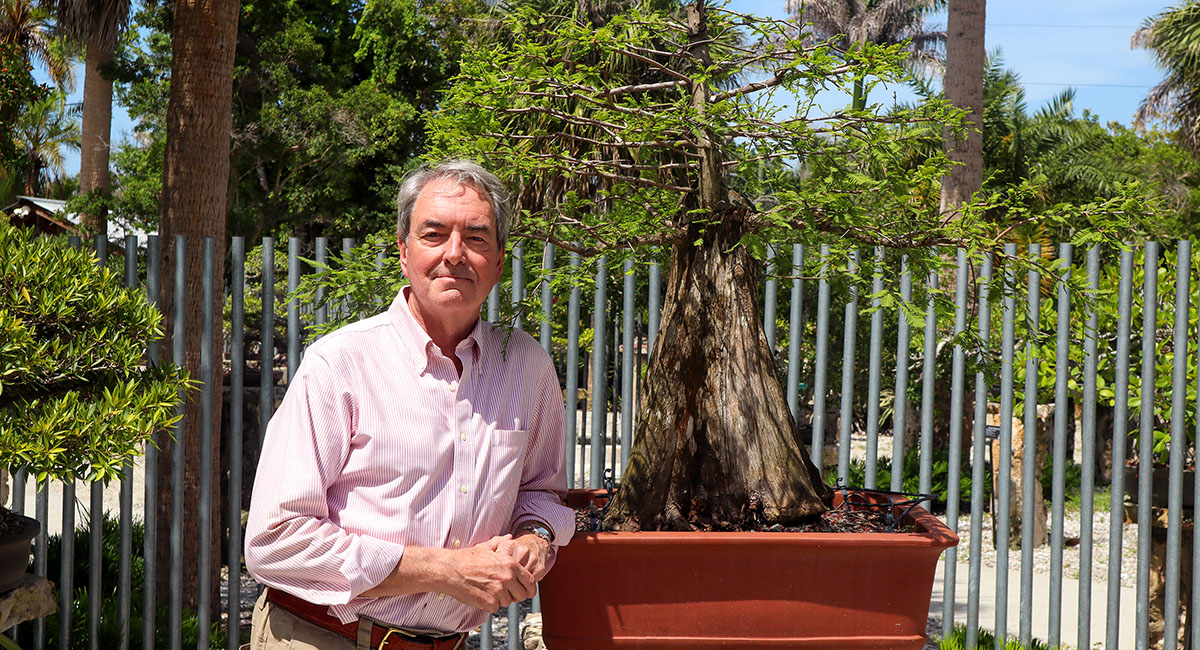
Tom Kehoe is both curator of a vast bonsai collection and a marksmanship instructor. ELLEN GILLETTE

Asian thought inspired storyteller, marksman, bonsai artist

Palm Bay’s Tom Kehoe got his college degree in journalism, but he has spent a lifetime learning Asian philosophy: its ethics, aesthetics and focus on living in harmony with nature.

His hometown of Martinsville, New Jersey, didn’t have a hospital so Kehoe was born in nearby New Brunswick. After his parents divorced when he was 1, he was raised primarily by his grandmother. Times were tough and money was tight, but the area was great for little boys who loved to explore. 

“If you go up the edge of a mountain, you’re suddenly in suburban New Jersey,” he said, “But there were cows and horses, a garden. Today it’s all McMansions.”

Kehoe and his friends played along stone roads and found lead balls embedded in old trees. “When I was in college, some archaeologist ‘discovered’ it. Turns out it was George Washington’s military academy, where he trained his troops.”

His own training, which began at age 12, changed Kehoe’s life. “Martial arts made me confident, more athletic,” he said. “I became deeply spiritual, wanting to find out what it all meant.”

He became obsessed with all things Asian. “My sister bought me a wok when I was 16.” About the same time, someone gave him a book on bonsai: the ancient art of growing trees in small containers. “I thought, ‘I have to do this!’ I got a juniper and killed it within a week.”

An avid reader — “Books were a refuge” — he pored through college texts while still in elementary school, but says he was a “lousy” student. “I didn’t get serious until I went to college. Interesting tidbit: I held the class-cutting record my senior year of high school. Seventy-six days, but I passed.”

Kehoe graduated from Bridgewater-Raritan High School East. “My junior year, we bought sweaters for the cheerleaders with letters for the school: B. R. EAST. The joke was that the football players were so dumb they had to label the parts of the cheerleaders.”

At Rutgers University, he prepared for a career in journalism, landing a job with media giant Gannett. “All I really ever wanted to do was tell stories,” he said. While a reporter for the local paper, he was “loaned” to USA Today in Washington, D.C., for a few months, ostensibly for training. “The truth is, it was just cheap labor.”

Ten days before he was scheduled to return home, he went on a date with a co-worker. Belinda was a researcher. “This was before the internet,” he said. “She’s very bright, has a couple of master’s degrees. Reporters would say ‘I need background on this technical subject’ and she would track it down.”

They got married four months later. Living in a restored Victorian house in New Jersey, they struggled financially. 

“It cost $700 a month to heat the house, and that was 35 years ago!” 

NEW PLACE, NEW GOALS

A double job offer from Florida Today moved them to the Space Coast. Belinda ran the research department; Kehoe was eventually director of operations. After retirement, he opened his own business: Malabar Gunleather, which made and sold custom holsters and belts. It catered to the growing civilian market for concealed-weapons equipment.

His interest in guns began in childhood. “Mom sent me to a Cub Scout camp. I was a gawky, nerdy kid. I couldn’t climb a rope. I couldn’t paddle a canoe. But put a .22 in my hands and I put holes in the center of the target every time.” By the age of 13, he shot competitively. 

Today, he is a chief instructor at Port Malabar Rifle and Pistol Club, scheduling and conducting firearms training classes. He also coordinates safety operations. “Marksmanship is teaching people to shoot rapidly and with focus,” he said.

One day, he was invited to a week-long event with Project Appleseed, a nonpartisan, apolitical nonprofit that teaches the fundamentals of marksmanship, along with American Revolutionary War stories: a perfect storm combining his love of history, shooting and storytelling. 

The event featured an actual storm.

At 4:00, the sky turned dark, with a driving rain, the wind whipping. “The bottom target line literally ripped out of the ground,” Kehoe said. “Targets were swinging. It was probably the best shooting I’ve ever done in the worst possible conditions.”

He is now chairman of the local chapter of Project Appleseed. “It’s kind of a civics lesson disguised as a marksmanship course,” he said. “At our shoots, you’ll hear about Lexington and Concord, about the Minutemen. 

“The goal is to inspire sleeping Americans. Too many people spend their lives on the couch. It doesn’t matter if you’re on the left or the right, no one’s happy, and the only people who can fix it is us. We need good people to get involved. We don’t care what religion you are, what color your skin is, your politics. Good people can work together for common goals.”

BACK TO BONSAI

Kehoe has been through many changes, but the Asian influence on his life has never faltered. Nor did his interest in bonsai. After his first failed attempt, he periodically bought — and killed — other trees. The first present he gave Belinda was a bonsai. It survived a whole two weeks.

The couple lived in Florida for several years before they visited a backyard nursery in Malabar. Belinda walked over to Kehoe with a tray holding nothing more than a stump. “This is a bonsai,” she said. “Or it will be.” 

Kehoe asked for general guidelines from one of the nursery’s employees. “Two weeks later it was still alive. Four weeks later. By the time six weeks rolled around, we had three little trees.” 

The nursery also told them about bonsai master Jim Smith in Vero Beach. Wanting to learn more, the Kehoes took a day off from work and drove to meet him: the start of an apprenticeship that lasted 25 years. 

As Smith grew older and it became difficult for him to take care of the trees, Kehoe assisted. “When he decided to give his collection to Heathcote [Botanical Gardens], we spent about two years prepping them. It was like a master’s degree program in bonsai, achieved the traditional Japanese way: He’d do one half, and have me do the other half the same way, adjusting my technique.

“When you’re a master in the Asian sense, you become the art,” he said. 

“[My martial arts teacher] would literally eat, drink and sleep martial arts. Jim Smith was the same way with bonsai.”

Smith passed away in 2016, but his donation to Heathcote became the foundation for America’s largest public bonsai display. Kehoe joined the board of directors and is curator of the bonsai gallery. Several times a week, he travels to Fort Pierce to maintain the collection. He also teaches bonsai classes.

“Most people don’t realize that bonsai is a form of art,” he said. “There are styles. Rules. I started doing it when I was still in the corporate world. It was my stress relief. I’d go to the backyard and work on my trees. I talked to them; they talked back. It’s a very zen sort of thing. You get quiet. You become aware of what’s going on around you.”

In a sense, Kehoe has always been a craftsman with a keen eye: as a storyteller, as a marksman, and as a bonsai artist. But perhaps his greatest gift has been his choice to pass on his talent and knowledge — in all its facets — to others.

To learn more about Heathcote’s bonsai collection: 

Visit heathcotebotanicalgardens.org 

Click on About, then Our Living Galleries.

Interested in Project Appleseed? 

Visit appleseedinfo.org

THOMAS ALAN KEHOE

Age: 67

Lives in: Palm Bay

Occupation: Business owner; part-time curator at Heathcote Botanical Gardens in Fort Pierce; chief instructor at Port Malabar Rifle and Pistol Club

Family: Wife, Belinda; sons, Lee and Riley; two grandchildren

Education: Bachelor of arts in communications, journalism and related programs from Rutgers University, New Jersey; various professional certifications

Hobbies: Bonsai, wildlife photography, target shooting

Who inspires me: “I didn’t have a very happy childhood, and when I was about 12 years old, I realized that the only person who could save me was me. I convinced my mother to let me take martial art lessons. I thought I would study for about six months, but stayed with the one school in the little town where I grew up for 17 years. It made a huge impact on me.”

Something most people don’t know about me: “I had an accident when I was 28 that mangled my right hand. I was making a cradle for my sister, and my hand was sucked under a radial table saw. It took about 10 years to heal and I had to give up a lot of things, including playing guitar and martial arts.”

See original article in print publication

Ellen Gillette