


Florida’s wildest cowboy
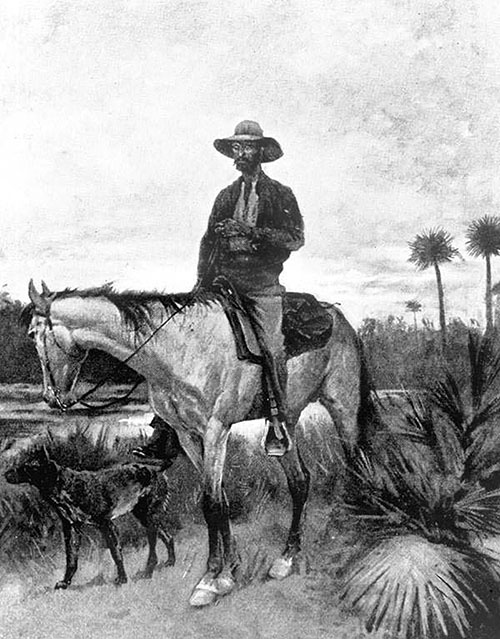
Artist Frederic Remington, best known for his depictions of the American West, captured Bone Mizell during a visit to Florida in 1895.
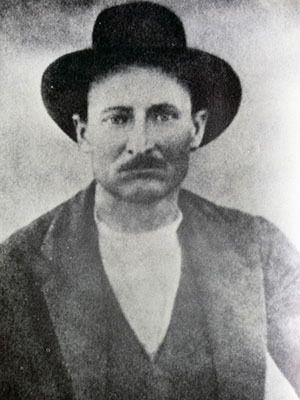
Cracker cowboy Bone Mizell lived from 1863 to 1921.
You have to respect a man who brands a cow with his teeth.
It was a hot day in 1892 as Bone Mizell and two cowpoke companions rode the brush flats of central Florida in search of stray cattle. They spotted a tawny bag of bones with murderous horns — but no brand — at the edge of a thorny thicket.
Bone’s boss, Buck King, challenged, “Rope her and put your mark on her and you can have her.” Determined to rope the thin but tough old cow and to put his mark on her ears, Bone spurred his horse and took out after her.
In an instant, his rope snaked through the air to settle around the horns of the sullen brute who was snorting and blowing. Bone quickly dismounted, went hand over hand along the rope and threw her down. But as he reached for his sharp jack-knife to mark her, the pugnacious old beast sensed that only one hand was holding her.
She began lurching, and Bone’s knife went sailing through the air. And seconds later, the cow sent him cart-wheeling into the scrub. For the next several minutes, the air was filled with a mixture of Mizell’s blue haze of profanity and the wild longhorn’s loud bawling. Man and cow battled for the upper hand.
Finally the commotion ended, and Mizell stumbled out of the brush, his clothes ripped, his face skinned, his hair tangled and his whiskers dripping blood. His lariat dragged along the ground behind him.
His companions began to laugh and chided him for letting an old range cow best him.
“Go ahead and laugh,” he said, “But I marked her like I said I would.”
“You’re lying, Bone,” one cowpoke said. “We seen you lose your knife when she threw you in the scrub. How could you mark her?”
“I didn’t need a knife,” Bone replied. “I marked her with my teeth.”
Driven from the scrub, the painfully surprised cow displayed two bleeding ears bearing the daredevil cowboy’s registered mark. They were chewed into her ears almost as neatly as if he had cut them with a knife.
Ornery, tough and an incurable joker, Bone Mizell left his mark, however dubious, on the pages of Florida’s history. In time, he may prove to be the state’s best known, if not most typical cowboy.
Tall, rawboned and tanned to the color of a new saddle, Bone was a lean and lanky, hook-nosed cowpoke who sighed with a wheeze and talked with a lisp. He lived alone, mostly on the range, and never owned a home. He never married because he was too much of a cutup for a woman to take seriously.
Bone was always up to something. His life was a series of adventures and pranks. His biography is a collection of anecdotes. Stories about the witty Bone and his escapades are many and have been handed down by cowboys, ranchers, cattle kings and others.
The crowning stunt of Bone Mizell’s life, and the one that brought him the most notoriety, was a rather gruesome joke he played on a Vermont family. Coming when it did, while memories of the War Between the States were still plentiful, everybody passed it off as a Rebel finally getting even with a Yankee.
At the time, Bone ran a ranch and when a young Northern runaway asked for a job, Bone hired him. The scapegrace repeatedly told Bone he never wanted to go home. But unaccustomed to the Florida mosquitoes and malaria so common in those days, the young man soon died.
One of the young man’s relatives came down to hire someone to exhume the body and send it back home. Someone recommended Bone, and the relative found the cowboy in a bar, one of his favorite hangouts.
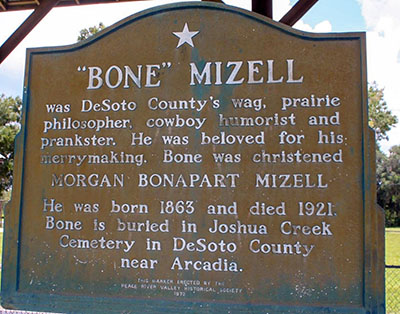
This historical marker in DeSoto County memorializes Bone Mizell’s wit and humor.
Bone immediately sensed the situation and allowed as how he couldn’t possibly go on such a journey unless he had a wagon, plenty of horses and one or two extra men to help him. Someone had to take care of the cooking and someone had to drive the wagon. Bone wasn’t about to do any heavy work.
And, of course, he would need enough supplies for this group for several days. All of this would require several hundred dollars. The relative agreed, and Bone rounded up a crew and led them to the burial site with good intentions. However, before a shovel was stuck into the ground, a thought struck him.
“Boys,” said Bone, “That rich fellow has been everywhere and seen everything. Poor ole Bill Redd, buried over there, hadn’t never traveled none. His long ambition was to take a train ride. Now’s our chance. Let’s give him a good, long ride. It won’t make no difference to the rich boy nohow.”
The idea was greeted with a storm of applause, and old Bill had his trip – a long train ride to Vermont where the waiting relatives reburied him in the family plot without knowing the difference.
So somewhere, an old Florida derelict cowboy lies in a stately grave he never dreamed of, and a disillusioned boy sleeps in the loneliness he wanted to find.
A similar joke was played on Bone once. A group of wild cowboys found him passed out, put him in a pine box used for shipping caskets and addressed it to San Antonio, Texas.
The train was far up the line when Bone awoke and discovered himself boxed. Thinking he had been buried alive, he began kicking, pounding and hollering. He threw the sleepy express car attendants into a frenzy, but managed to escape and get back home.
Bone’s busy life came to an end July 14, 1921, while he waited for a train to Tampa. Although at least one person reported that Bone died of a heart attack, the death certificate gave the cause as “Moonshine — went to sleep and did not wake up.”
In 1974, the Peace River Valley Historical Society unveiled a historical marker honoring Bone in Zolfo Springs. It is a suitable tribute to the kooky cowboy who is a symbol to Florida’s frontier folklore.

Jabbo Gordon
Jabbo Gordon is a veteran newspaperman and assistant adult sailing director for YSF Community Sailing in Vero Beach.