

Nature calls
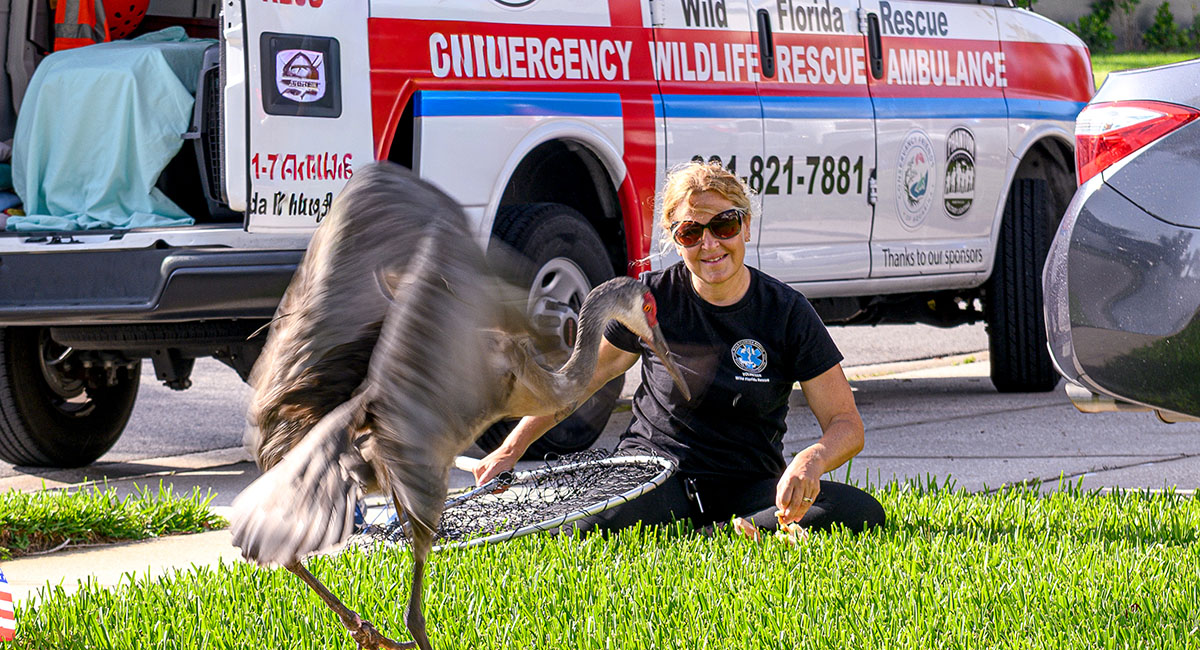
Heather Pepe earns the trust of a sandhill crane in order to check its swollen leg. TOM WILBY
When an egret needs an EMT, Wild Florida Rescue is there
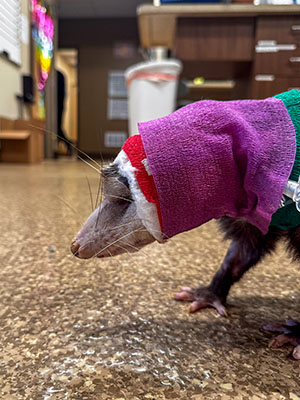
Wild Florida Rescue ambassador opossum, O’Gally, looks well-dressed as she recuperates. Her name honors Eau Gallie Veterinary Hospital, which provided her with life-saving surgery after being hit by a car. WILD FLORIDA RESCUE
He was struggling with a badly injured neck, when a passerby stopped to help. The Good Samaritan called emergency responders, who quickly arrived in an ambulance fitted out to stabilize the patient and get him to a facility that could treat his injuries. For his own good, the patient was caged.
Caged?
Well, he was a great blue heron with a long and powerful beak, and his saviors were volunteers from Wild Florida Rescue. One of Brevard’s most unique nonprofits, the group is dedicated to connecting injured wildlife with rehabilitators who can mend them.
“We’re an ambulance — that’s our mission,” said Baleen “Heather” Pepe, the organization’s cofounder and chief operating officer. “We get the animals to where they need to go.”
Depending on its species and its injury, a creature may stay with the organization’s state-permitted rehabilitator, or it may be transported to Florida Wildlife Hospital in Palm Shores or to a facility that treats a specific type of animals. Eau Gallie Veterinary Hospital also takes in patients, and several other vets jump in to help.
The need is certainly there: Last year, Wild Florida Rescue received 8,745 calls on its 24/7 Wildlife Emergency Hotline.
“This year, we’re going to surpass those numbers,” Pepe said. “It’s a struggle to keep up with the growing numbers.”
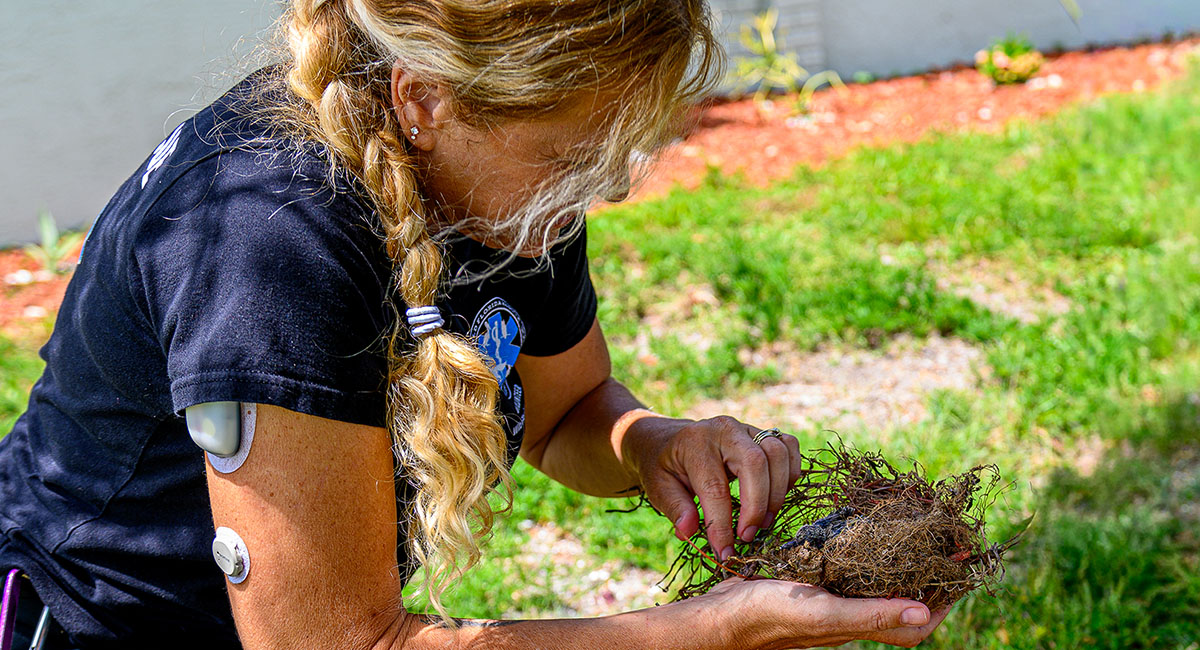
Pepe attempts repairs on a fallen nest. TOM WILBY
GO TIME
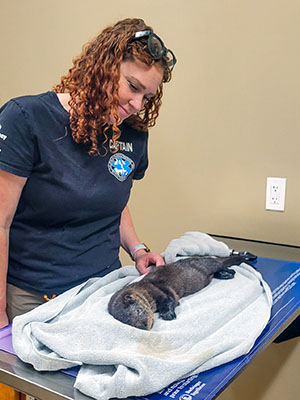
Adriane Crawford works with an orphaned, rescued otter during an emergency exam.
Pepe and Matthew Buice — both big-time animal advocates since childhood — founded the organization in 2016. At the time, they were working together at a local animal hospital, where they saw the need for an organization to help transport injured wildlife.
“Most rehabbers can’t offer pickup, due to availability of resources, so Good Samaritans are asked to somehow safely catch, box and transport a wild animal,” Buice said. “It seemed incredibly dangerous for people and the animals — and likely increases the [chances of] stress or injury of that animal, if it could even be captured.”
The pair began working out the details to launch such a service, devoting all their available time to preparing the tools and equipment needed, as well as obtaining the necessary permission to start. “It was a massive undertaking, to start as professionally as possible and be looked at as a legitimate rescue organization,” Buice said.
In the beginning, Pepe and Buice were the program: transporting animals up and down the county, and doing community talks and fundraisers to raise awareness and make ends meet.
“We’ve had people wait up all night to keep eyes on an animal, while we drove to the other side of the county for it,” Buice said. “People want to help.”
Pepe and Buice set out to adapt emergency medical systems for humans to the needs of wild animal patients. Through donations, Wild Florida Rescue obtained two well-equipped ambulances that can be seen zipping around town, answering the approximately 50 calls for help received daily.
“They look like the little ambulances they have in France,” Pepe said.
Headquarters is Satellite Beach’s old fire station, which Wild Florida Rescue shares with city offices. Here all the tools of the wild rescue trade are stored: kayaks, cages, waterproof swamper boots, camouflage suits, nets and a Jon boat. A triage room holds small mammals, usually orphaned babies for rehabilitation or other incoming wildlife that needs stabilization before being returned to the wild.
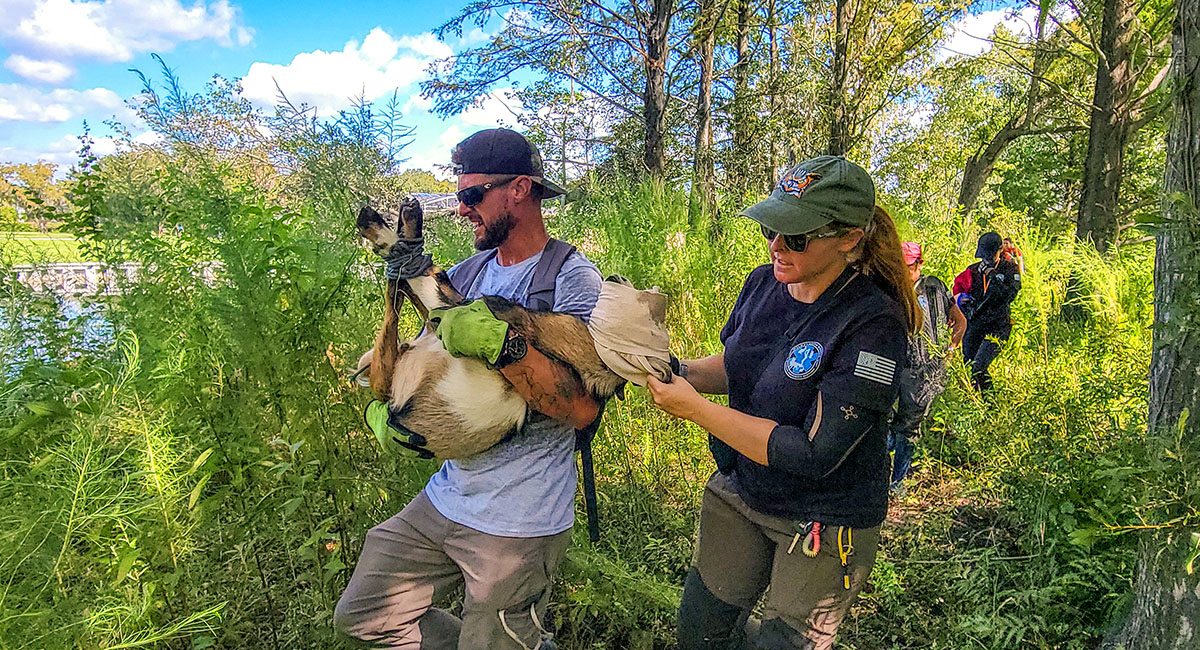
Chad White and Jenn Miller rescue a goat, one of two dumped on an island near St. Cloud. Its partner was taken by a gator. The goat has since found its forever farm
TEAMWORK
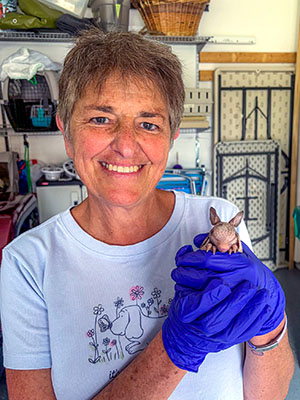
Hayes cares for an orphaned armadillo. WILD FLORIDA RESCUE PHOTOS
Calls for help come from a variety of sources: individuals, businesses, municipalities and even county animal services, which is tasked with helping domestic animals, not the wild ones.
Wild Florida Rescue is part of a network of people and organizations dedicated to assisting wildlife. Florida Fish and Wildlife Commission are primarily the law enforcers. Sea World has the chops to help manatees. As for sea turtles in trouble, the Sea Turtle Preservation Society and Brevard Zoo are the go-to organizations. Florida Wildlife Hospital has a full-time veterinarian, plus experienced staff and volunteers, to treat more than 200 species. Home-based, state-permitted wildlife rehabilitators, such as Crystal’s Critter Care and Rescue, also do their share to help. Municipalities will help when rescuers require special equipment, such as a bucket truck, to reach the animal.
“Collaboration is tremendous,” Pepe said. “We’re all on the same team.”
In fact, Wild Florida Rescue has such an outstanding record that it has become a resource for other counties interested in starting such a service.
Approximately 40 volunteers, including six fully trained ambulance drivers, keep Wild Florida Rescue running. A typical day might include ferrying a white ibis with an injured leg to Florida Wildlife Hospital, providing a temporary home for orphaned bunnies, or rushing an opossum mauled by a dog to a local wildlife rehabilitator.
While its main mission is transportation to emergency care resources, Wild Florida Rescue can sometimes step in to reset what could have otherwise been a dire future for some critters. When a neighbor cut down a tree in his yard, Palm Bay resident Kathy Bean noticed a family of woodpeckers was living inside it. She saved the section of the tree where the nest was located and called Wild Florida Rescue. Pepe and her team promptly arrived.
“They decided to use bungee cords to anchor that section of the palm tree with the nest and babies up into our camphor tree, just a short distance from the original palm tree,” Bean recalled.
“It worked! We soon had mom and dad back inspecting, and the babies made it. The bungees became too weathered through the years and the palm section was removed, but they lived there enjoying their home for a long time, thanks to Wild Florida Rescue.”
PAYBACK
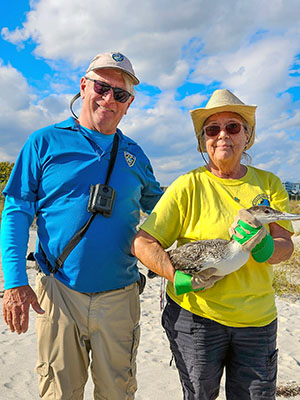
Wild Florida Rescue volunteers rescue a loon stranded during migration. WILD FLORIDA RESCUE PHOTOS
Unfortunately, volunteers still face a lot of heartbreak.
“There are a lot of animals that are in such bad shape that we know they will have to be put down or will die,” Pepe said. “We get them to where they need to go safely and compassionately — and with a lot of our prayers. It is up to the vet or the rehabilitator to determine if euthanasia is recommended. We get every animal to the best-case scenario for their situation.”
It’s not a job for everyone — even the well-meaning. “Many don’t make it past the first month, but those who stay are enthusiastic and feel so truly good about what they are doing,” Pepe said.
Volunteers are trained in dispatch and rescue, as well as procedures and protocol that ensure wildlife laws are being followed. They are needed in the field, as well as for administrative duties and special events. While ambulance drivers commit to an eight-hour shift, once a week, other volunteer positions have no minimum.
Alice Hayes has been a volunteer since 2019, when the Satellite Beach veterinary technician happened to see a rescue in person. She knew she wanted in.
Now, she says, “I’m pretty much involved every day.”
She has become the official rehabber for the organization, taking care of small mammals, such as O’Gally, the group’s ambassador opossum, who can’t be released because she can’t see. In the past, Hayes was involved in some pretty intense rescues, such as saving an anhinga entangled in fishing line — upside down, over a lake. The task involved kayaking to the bird and bringing it back to shore to free it from the line, while avoiding being pecked by its powerful, barbed beak. Once the barbs puncture the skin, the bird doesn’t let go. So, an anhinga peck means the rescuer must head to the emergency room — bird attached.
She has had her scalp torn by a great horned owl and been hit in the face by a cormorant. But the work is a calling for her. “With all the pain and suffering humans cause animals, I feel we should help them whenever we can,” she said.
Donations are crucial for the organization, which receives no other funding. “It costs a lot to keep rescue vehicles in operation, equipment in working order, fuel, annual fees and training costs,” Buice said.
“Wild animals can’t pay their bills.”
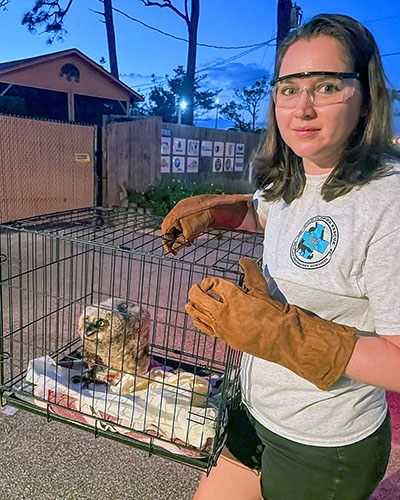
Blayne Schacht helps a great horned owl. The young bird was injured after falling from its nest in Micco. All’s well that ends well, however, after Wild Florida Rescue transported the fledgling for needed care. WILD FLORIDA RESCUE
Help Wild Florida Rescue
Consider donating your time, talent or treasure to Wild Florida Rescue, a nonprofit that receives no government funds. The organization is desperately seeking a grant writer. Whether you’re passionate about rescue operations, wildlife care or raising awareness, your support of Wild Florida Rescue can save the lives of the many amazing creatures that share Brevard County with us.
For more information, visit wildfloridarescue.org.
If you see a wild animal in trouble, contact the Wild Florida Rescue Wildlife Emergency Hotline at 321-821-7881.