


Grace beyond sight
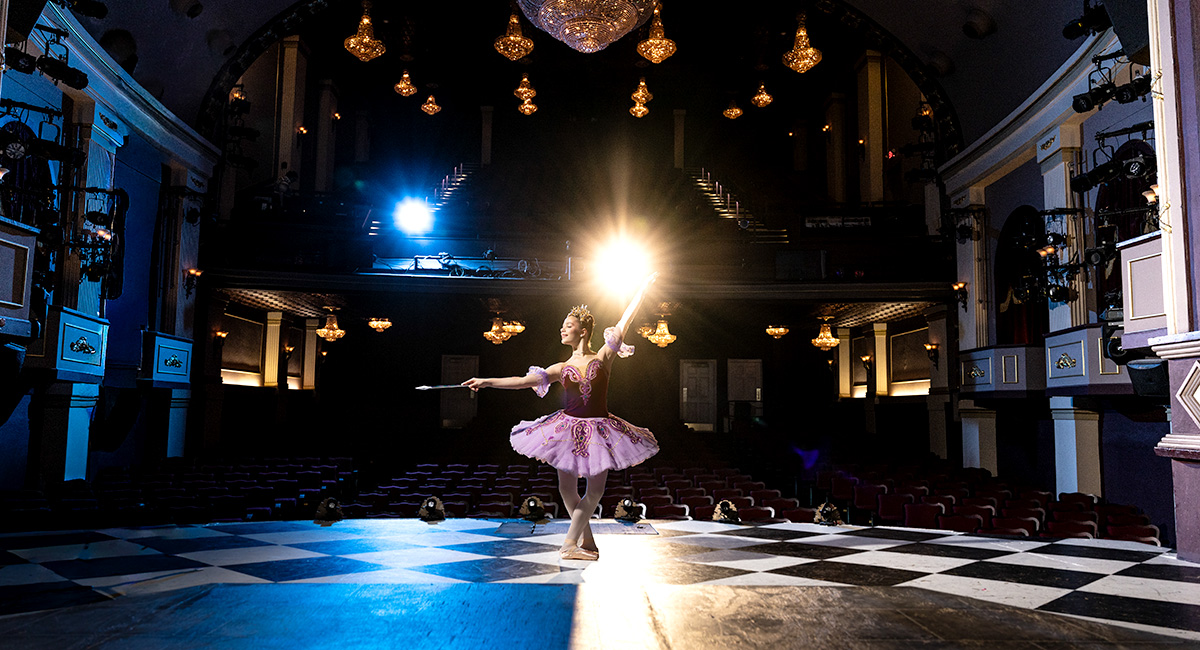 Legally blind since birth, 14-year-old Melbourne ballerina Lily Small is taking on one of ballet’s most coveted roles, the Sugar Plum Fairy in The Nutcracker
When 14-year-old Lily Small takes the stage as the Sugar Plum Fairy in The Nutcracker this December, audiences will see a graceful young ballerina dancing on the tips of her toes, turning to Tchaikovsky’s familiar score and making it all look effortless.
What they won’t see is the extraordinary challenge the Melbourne teenager faces every time she dances.
Lily is legally blind.
Born with a rare eye condition that severely limits her vision and depth perception, Lily has learned to navigate the demanding world of ballet largely through muscle memory, instinct and years of practice. This year, she’ll dance one of ballet’s most coveted roles for the first time.
Lily will perform as the Sugar Plum Fairy Dec. 18-20 with Galmont Ballet at the Historic Cocoa Village Playhouse. The company has staged The Nutcracker there since 2004, making it Brevard County’s longest-running production of the holiday classic. The production was reimagined and choreographed by Galmont co-founder Frank Galvez, who continues to coach students with his wife, Lucia Montero.
“Lily came to us very young,” Montero said, “but she showed an unusual level of maturity, discipline and artistic ability.”
Galvez spends hours rehearsing with Lily as she prepares to dance with a guest principal from Canada’s Les Grands Ballets. The elegant movements audiences see onstage require grueling preparation, particularly dancing en pointe, a technique in which ballerinas support their weight on the tips of their toes.
Lily’s mother, Heather Small, says ballet teaches far more than graceful movement. “It requires an incredible amount of focus,” she said. “Unless you’ve been immersed in it, you just can’t understand.”
Even Heather sometimes marvels at how her daughter manages it.
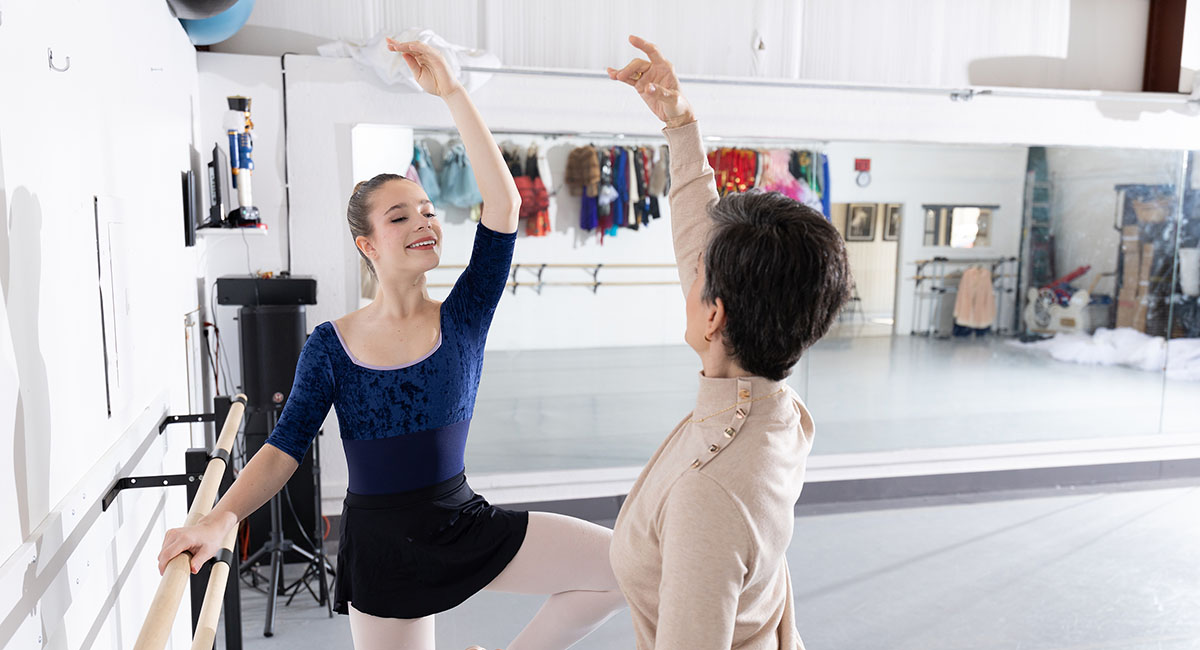
Galmont Ballet instructor Lucia Montero works with Lily Small on positioning and technique during rehearsal. Montero has watched Lily develop from a young student into an accomplished ballerina preparing for one of classical ballet’s most recognizable roles. JASON HOOK
A DIFFICULT DIAGNOSIS
A young Lily Small practices at the barre during her early years with Galmont Ballet. She began taking lessons at age 6 after attending a performance with her older sister, Tori, who also went on to dance the role of the Sugar Plum Fairy. SMALL FAMILY
Lily was born with bilateral coloboma, a rare congenital condition affecting about 0.01% of newborns. The condition occurs when parts of the eye fail to develop completely before birth.
“In utero, the eyes form into spheres, but Lily’s just stopped at a certain point,” Heather said. “She has very low vision, with gaps inside both eyes. She lacks depth perception. Parts of the retinas are missing.”
In some people, coloboma affects only the iris, giving the pupil a keyhole or cat-eye appearance. Lily’s condition is far more extensive, affecting multiple structures in both eyes.
The openings extend from the irises at the front of her eyes to the back, affecting the retinas, maculas and optic nerves. Because of the size and location of the defects, Lily has gaps in her vision, particularly in the upper half of her visual field.
Her father, Jeff Small, owner of Arbor Financial Services, remembers the devastation of hearing a neonatologist say his newborn daughter would never see. “Our hearts sank, and we turned to God,” he said. “An army of people prayed for her.”
The family began preparing for a life without sight.
“We planned to move to St. Augustine,” Heather said, “because the Florida School for the Deaf and the Blind is there. We bought devices, thought she’d have to learn Braille.”
Then something unexpected happened.
During a therapy session, a vision therapist waved a shiny piece of gold paper in front of baby Lily’s face. Her eyes followed it.
By age 5, Lily had been identified as a visual learner, although her eyes processed information more slowly than those of other children. “There’s been miracle after miracle,” Jeff said.
Lily’s vision remains severely limited and can fluctuate. Because of the risk of retinal detachment, she must avoid many sports.
But those limitations haven’t kept her from pursuing a remarkable range of interests.
Now a freshman at Holy Trinity Episcopal Academy, Lily is a first-chair flutist who enjoys writing stories, baking and spending time with friends. And, of course, there’s ballet.
Playing the flute presents its own challenges. To read sheet music, Lily uses large print or an electronic device that allows her to magnify the notes. She uses the same approach when reading books and completing schoolwork. Even then, she must take frequent breaks because her visual field sometimes narrows, causing words and musical notes to become blurry and appear to shake.
Bright light presents another challenge. Because her eyes cannot filter light normally, sunlight can be especially intense.
The Small family also participates in a National Institutes of Health genetic study led by Dr. Brian Brooks to identify genes responsible for coloboma. Lily periodically visits the NIH for follow-up examinations. Currently there is no cure for coloboma.
LEARNING TO ADAPT

Lily Small’s artistic interests extend beyond ballet. A first-chair flutist at Holy Trinity Episcopal Academy, she also enjoys playing the piano, writing stories and baking.
From an early age, Lily found ways to compensate for what she couldn’t see. “She was never given special treatment, but she learned to adapt,” Heather said.
Her mother remembers watching Lily explore a multilevel playground structure for the first time. Unable to judge distances easily, Lily moved cautiously, using her foot to feel for changes in elevation.
Once she had made her way through the equipment, she knew what to expect and moved with confidence.
Glasses help keep Lily’s eyes aligned. Surgery corrected one eye’s tendency to drift, but operating on her dominant eye was considered too risky. “One of her eye doctors said hers was the most complex case he’s ever seen,” Heather said.
Not all the challenges have been physical. “Growing up in one school, Lily was accepted for who she was,” Heather said.
Moving to a new school in seventh grade meant adjusting to unfamiliar classmates and surroundings. It wasn’t easy, but Lily gradually found her place.
Recently, she invited friends over before Holy Trinity’s homecoming festivities. They enjoyed treats she had baked and arranged flowers to complement their outfits. “I call it Brunch and Bouquets,” Lily said.
It’s the sort of gathering that reflects her personality: creative, outgoing and determined to enjoy the same experiences as other teenagers.
FINDING HER PLACE IN BALLET
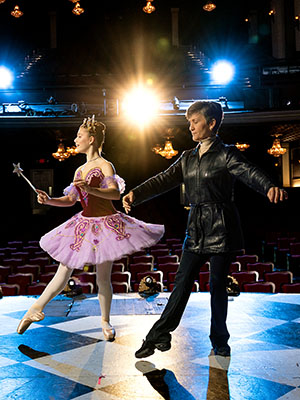
Lily Small rehearses as the Sugar Plum Fairy with Galmont Ballet instructor Lucia Montero at the Historic Cocoa Village Playhouse. She will perform alongside a guest principal dancer from Canada’s Les Grands Ballets in the company’s December production of The Nutcracker. JASON HOOK
Lily’s introduction to ballet came when Heather took her and her older sister, Tori, to see a Galmont Ballet performance. Both girls were captivated, and Heather enrolled them in classes.
Lily was 6 when she began training. Tori also excelled and has previously danced the role of the Sugar Plum Fairy. For Lily, ballet quickly became more than an extracurricular activity. “I’ve always had a passion for dance,” she said. “It calls to me.”
The Sugar Plum Fairy is among the most recognizable roles in The Nutcracker, requiring technical precision, strength and artistry. It is a role earned through years of training.
“Soloists are coveted roles,” Montero said, “but you learn to be a real dancer in the corps. We take pride in what Lily has accomplished; Frank started working with her when she was very young.”
For most dancers, mastering turns is difficult enough. For Lily, it presented an additional obstacle. Ballerinas typically use a technique called “spotting,” fixing their gaze on a single point as they turn to maintain orientation and reduce dizziness. Lily’s limited vision makes that difficult. Galvez developed an alternative technique to help her turn successfully.
“When I learn choreography, I try to make every move as precise as possible,” Lily said. “Muscle memory guides me; my subconscious guides me. I try not to worry and let myself go.”
Dancing with a group presents another challenge. Lily must maintain precise spacing and timing even when she cannot clearly see the dancers around her. “In the corps, with a ton of kicks or arm movements, I feel the wind [as nearby dancers move] and estimate how far away I should be,” she said.
It’s an extraordinary combination of training, awareness and trust.
And when Lily steps onto the stage, her parents see much more than a ballet performance. “It is miraculous, after going through so much, to see her on stage,” Jeff said.
DANCING TOWARD THE FUTURE
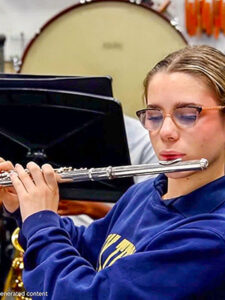
Lily Small, a freshman at Holy Trinity Episcopal Academy, plays the flute during band practice. She uses enlarged sheet music or an electronic device to magnify musical notes, allowing her to pursue her passion for music. SMALL FAMILY
Lily has studied with the Central Pennsylvania Youth Ballet and dreams of attending a ballet conservatory full time. For now, she’s concentrating on school, training and her upcoming performance.
Her instructors believe she has the talent and determination to pursue ballet professionally. “Lily has a vibrant personality that says, ‘I’m here. I’m present,’” Montero said. “She isn’t afraid of anything.”
Galvez is equally optimistic. “We believe Lily will be a very strong professional ballerina,” he said.
Lily knows she has benefited from supportive parents, dedicated teachers and years of specialized coaching. But she also understands that success requires something no one else can provide: her own determination. “Always try and look for outlets [for your passion],” she said. “There’s always a way. Never give up.”
And this December, when the curtain rises and Lily steps into the spotlight as the Sugar Plum Fairy, the audience will see what years of determination have made possible.
